
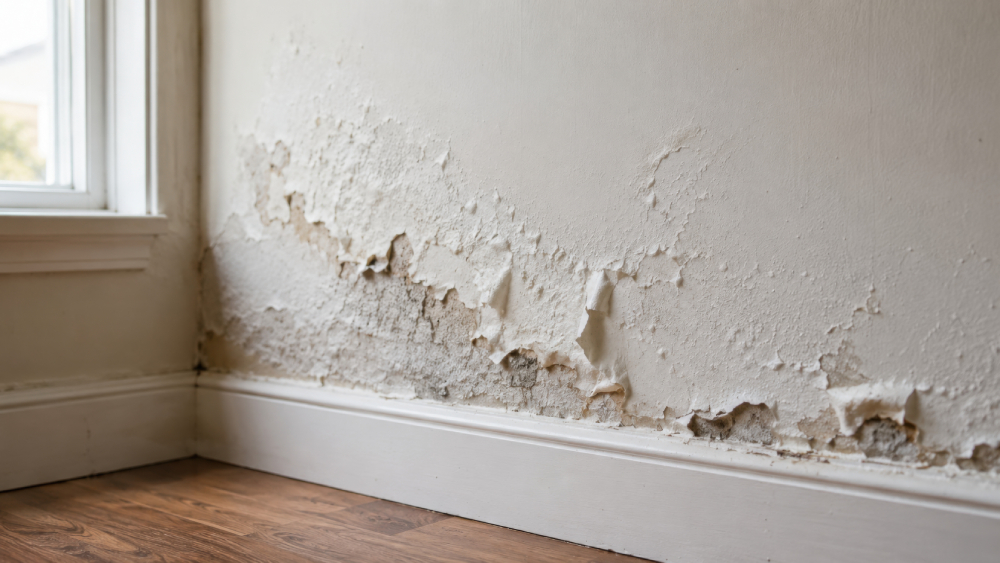
Coastal buildings face a different interior climate than inland construction. Humidity, condensation, and salt-laden air act on walls, ceilings, and framing continuously, not occasionally, and a specification written for a dry inland climate will not hold up along the Red Sea coast. Hotels, hospitals, schools, residential towers, and commercial buildings in Jeddah, Yanbu, Rabigh, and other coastal cities need interior systems chosen for that reality: the right boards, the right framing protection, and the right detailing at every joint and penetration, working together as one system.
Understanding Coastal Moisture Challenges in Saudi Arabia
Most of the moisture that damages interior partitions in coastal buildings never arrives as visible water. It arrives as humid air, moving through service penetrations, façade gaps, poorly sealed joints, and pressure differences between mechanically cooled interiors and humid exteriors, and condenses once it reaches a cold surface. That distinction matters for design: a wall can look and perform fine at handover while moisture is already collecting somewhere it can’t be seen.
Treating coastal humidity as a structural design load, not a finishing consideration, changes what “acceptable” looks like at the specification stage. Board type, framing protection, and joint detailing all need to be selected for what the building will experience over years of humidity cycling, not for how the assembly performs on a dry day.
Peak Humidity Seasons on the Red Sea Coast
Humidity along the Red Sea coast is most demanding during the warmer months, when higher air temperatures let the air hold more moisture and mechanical cooling widens the temperature gap between indoor and outdoor conditions. That gap is what drives condensation, warm, humid air meeting a cooled surface (a ceiling void, a poorly insulated stud cavity, a junction near an AC diffuser) sheds moisture onto whatever it touches.
The buildings most exposed to this cycle are the ones running mechanical cooling continuously: hotels, hospitals, malls, offices, and schools. If a partition or ceiling isn’t detailed to manage repeated condensation, moisture can accumulate behind finishes for months before it becomes visible. A system that performs well in a dry, unconditioned test setting isn’t a reliable predictor of how it behaves behind a hotel bathroom wall running 24-hour air conditioning.
How Salt-Laden Air Accelerates Material Degradation
Chloride particles carried in coastal air settle on exposed surfaces and readily attract moisture. On their own, salt deposits or humidity are manageable; combined, they accelerate corrosion on any metal that isn’t properly protected, which is why salt air corrosion, not humidity alone, is the bigger long-term threat to coastal interiors.
The components most at risk are the ones rarely inspected after installation: studs, tracks, screws, connectors, suspension components, and access panel frames sitting inside a finished wall or ceiling. Visible symptoms, paint blistering, staining, joint cracking, usually show up only after the underlying metal has already been corroding for some time. Protecting the full assembly at the outset is far more effective than trying to catch and repair surface damage later.
Why Standard Gypsum Fails in Humid Coastal Environments
A standard gypsum board is engineered for dry interior conditions, and it performs well in them. The problem isn’t the product, but its mismatch. Used in a space with regular humidity exposure, standard boards can absorb moisture, lose strength, sag, or telegraph defects through the finish. A dry office corridor, a hotel bathroom wall, a hospital service zone, and a coastal villa ceiling are not the same moisture environment, and specifying one board type across all of them trades a small procurement convenience for a much larger maintenance risk later.
How Moisture Attacks an Unprotected Gypsum Core
Moisture doesn’t usually attack a gypsum board through its face. It gets in through the edges, cut ends, fastener points, damaged paper facing, unsealed cutouts, and untreated joints, which is why the vulnerable points in a wet-area wall are often the details around the board rather than the board itself. Once moisture reaches the core, it can soften the gypsum, weaken the bond between the paper liner and the core, and reduce the board’s dimensional stability.
This is also why product selection alone doesn’t solve the problem. A moisture-resistant board still needs correct jointing, sealing, finishing, and site protection during storage and installation, the board is one part of a system that has to hold together at every seam.
Long-Term Performance Issues in Marine Climates
Marine-climate performance is a question of repeated exposure, not one-time contact with moisture. Across repeated humidity cycles, boards can swell and move, screws can stain the finish, joints can crack, mold risk can rise at cold spots, and paint can fail well before its expected service life. In commercial buildings, that shows up as disruption and unplanned maintenance. In healthcare and hospitality projects specifically, visible moisture damage also affects hygiene perception and guest experience in ways that are harder to quantify but just as costly.
A coastal specification should be judged on durability and serviceability over the building’s life, not just on how the assembly looks at handover, which means choosing a moisture-resistant board, protected metal framing, compatible insulation, and sealants that are documented to work together.
Moisture-Resistant Plasterboard for Wet and Humid Areas
Moisture-resistant plasterboard is built for interior areas where humidity or occasional moisture exposure is expected as a normal condition, not an occasional event. Mada’s fire- and moisture-resistant plasterboards use a gypsum core with additives and binders formulated to support both fire and moisture performance, which lets specifiers address two requirements, moisture durability and fire safety, with one board decision instead of two.
When to Specify Moisture-Resistant Boards
Moisture-resistant boards belong in bathrooms, washrooms, kitchens, laundry areas, service corridors, utility rooms, coastal ceilings, back-of-house hotel spaces, and healthcare support areas, anywhere humidity is a given rather than an occasional condition.
They’re worth considering more broadly than that, too: internal walls close to external façades, shaded balconies, mechanical rooms, and any zone with a heavy or constant cooling load can carry more condensation risk than the room’s stated function would suggest. The practical fix is to map moisture zones early and mark the transition points clearly on drawings and schedules, where standard board ends and moisture-resistant board begins, so the distinction survives from design through to site substitution decisions.
Performance Expectations for Coastal Applications
Moisture-resistant plasterboard manages humidity and intermittent moisture, it isn’t a waterproofing membrane and shouldn’t be specified as a substitute for one in areas with direct, continuous water contact. Its performance also depends on the surrounding conditions being right: boards stored dry, installed only after wet trades are complete, fixed to suitable framing, jointed with compatible materials, and protected from prolonged water exposure during construction.
Ventilation, HVAC balance, and finish coatings still do real work here too. A moisture-resistant board improves the assembly’s tolerance for humidity, but it doesn’t replace the need to control condensation and trapped moisture at the building level.
The AquaPlus Partition System for High-Moisture Zones
Boards, framing, insulation, and joints don’t perform independently, a wall behaves as an assembly, and a high-quality board can still fail if the frame behind it, the insulation inside it, or the joints around it are poorly detailed. Mada’s AquaPlus partition system is built around that fact: it’s a coordinated system for high-humidity interior zones, rather than a set of individually selected components a contractor has to reconcile on site.
Complete System Architecture and Components
AquaPlus combines moisture-resistant boards, metal framing, insulation, fixings, and jointing and finishing materials selected to work together for a given wall performance target, including configurations using Mada Glasswool insulation where acoustic performance matters alongside moisture resistance.
For specifiers, this narrows a lot of decisions that otherwise get made piecemeal on site. Instead of a contractor combining unrelated products under time pressure, the system defines compatible components up front, which supports more consistent installation and a clearer line between what was specified and what was built, across healthcare, hospitality, education, residential, and commercial projects.
Where AquaPlus Fits in a Coastal Specification
AquaPlus is intended for internal partitions where moisture resistance is a primary requirement, not a secondary one, humid residential and commercial interiors being the typical case. For coastal projects specifically, the right move is to request current technical data and system details directly from Mada’s technical team, particularly on buildings with demanding height, acoustic, fire, or service-integration requirements, where the assembly needs to be checked against project-specific conditions rather than assumed from a general product description.
Protecting Metal Framing from Salt Air Corrosion
Metal framing carries the structural load of a drywall system, but it’s also the part of the assembly least visible after handover. Boards and finishes can look intact for years while corrosion progresses behind them, which is exactly why framing deserves the same specification attention as the board in front of it, not less.
Why Zinc Coating Is the First Line of Defense
Bare steel has no resistance to chloride-laden coastal air, salt deposits, combined with ambient humidity and corrosion, can begin quickly. Coastal-grade steel framing is protected with a zinc coating precisely because zinc corrodes preferentially: it sacrifices itself to protect the steel underneath, a mechanism known as galvanic (or sacrificial) protection. That’s the actual engineering reason “corrosion-resistant framing” holds up on a coastal site, not a general claim about coating quality.
Two site details decide whether that protection actually works in practice. The first is coating continuity: every cut, drilled hole, or scratch made during installation exposes bare steel and breaks the zinc layer exactly where it’s needed. Minimizing site cutting, and orienting cut edges away from moisture paths where possible, preserves more of the coating than an assembly typically retains once installers are on site. The second is fastener compatibility: pairing coated framing with the wrong screw grade creates a galvanic couple between dissimilar metals, which can accelerate corrosion at the connection rather than prevent it. Framing, tracks, and fasteners need to be specified as a matched set for the exposure level, not assembled from whatever happens to be on hand.
Connection Details That Keep Moisture Out
Connections are where moisture problems usually start, because every junction interrupts the continuity of board, seal, and finish that protects the assembly elsewhere. Wall-to-floor, wall-to-ceiling, wall-to-façade, and partition-to-service-shaft junctions all need detailing that limits both air leakage and moisture entry, tracks properly fixed and aligned, board edges supported, and perimeter gaps treated with a suitable sealant.
In wet-service areas specifically, the partition system and any waterproofing layer need to be coordinated with the waterproofing specialist rather than detailed independently, a partition detail that conflicts with the waterproofing membrane creates a failure point regardless of how good either product is on its own.
Sealing Junctions, Joints and Penetrations
Small gaps are how moisture actually travels through an assembly, which is why pipe penetrations, cable openings, access panels, door frames, ceiling perimeters, and other service interfaces need the same attention as the main joints. Board edges should be cut cleanly, damaged edges shouldn’t be built over, and wet areas need finishing systems compatible with the board and joint materials. Where movement is expected, a flexible sealant prevents the cracking a rigid one would eventually show.
A practical handover checklist covers board type verification, framing protection, sealed penetrations, joint finish quality, perimeter treatment, ventilation performance, and any early sign of condensation, catching these before handover is considerably cheaper than fixing them after.
Building the Full System
Preventing moisture damage in coastal buildings comes down to treating the wall or ceiling as one system rather than a single product choice: the right board for the exposure, protected and correctly detailed framing, and sealed joints and penetrations throughout. For project-specific guidance, visit Mada Gypsum, learn more about us, or contact us to talk through a coastal specification for your project.